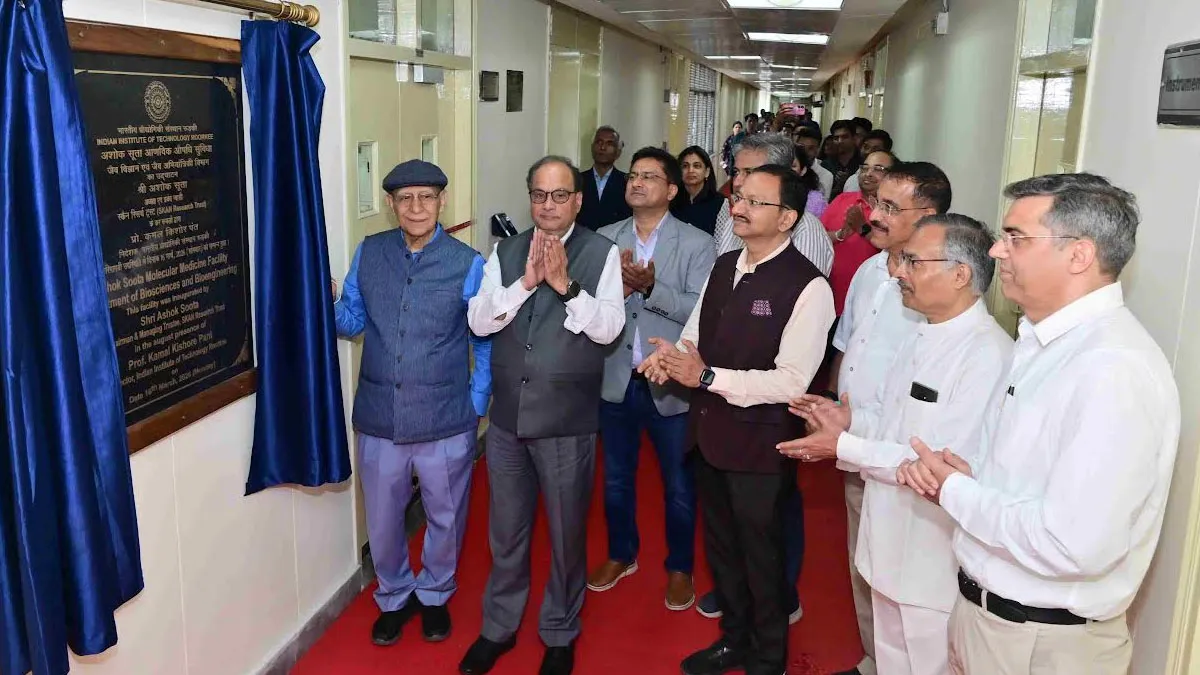
Roorkee: The Indian Institute of Technology (IIT) Roorkee inaugurated the Ashok Soota Molecular Medicine Facility today at its Department of Biosciences and Bioengineering (BSBE).
The center aims to catalyze India’s self-reliance in the biomedical sector by providing a unified platform for drug discovery and molecular diagnostics.
Established with support from distinguished alumnus and Happiest Minds founder Ashok Soota, the facility bridges the critical gap between decoding disease mechanisms and validating lead molecules.
The infrastructure targets high-burden disease domains including cancer, metabolic syndromes, and neurological disorders through an interdisciplinary approach.
It integrates specialized expertise in biophysics, structural biology, and analytical profiling to streamline the transition from theoretical research to experimental validation.
This launch comes at a time when India is aggressively expanding its “Biomanufacturing and Bio-foundry” strategy to position itself as a global leader in the bio-economy.
The facility’s focus on precision medicine aligns with the growing domestic shift toward personalized therapy, a market in India expected to see significant CAGR growth through 2030.
By centralizing tools like the Protein Crystallization Robot and High-Pressure Homogenizers, the institute reduces the dependency of Indian researchers on overseas diagnostic validation.
Prof. K. K. Pant, Director of IIT Roorkee, noted that the integration of such advanced infrastructure accelerates translational research and supports national healthcare priorities.
The facility is equipped with high-precision platforms including Automated Protein Purification Systems, Flow Cytometers, and Upright Confocal Microscopes.
These tools allow for end-to-end workflows, ranging from basic molecular characterization to complex biomolecular interaction studies required for modern vaccine and drug development.
Ashok Soota emphasized the necessity of building robust research ecosystems that translate scientific talent into tangible societal impact.
He highlighted that providing world-class infrastructure is essential for enabling innovation at scale within the Indian scientific community.
The center will function as a collaborative hub, opening its doors to industry partners and scholars to foster a culture of interdisciplinary biomedical engineering.