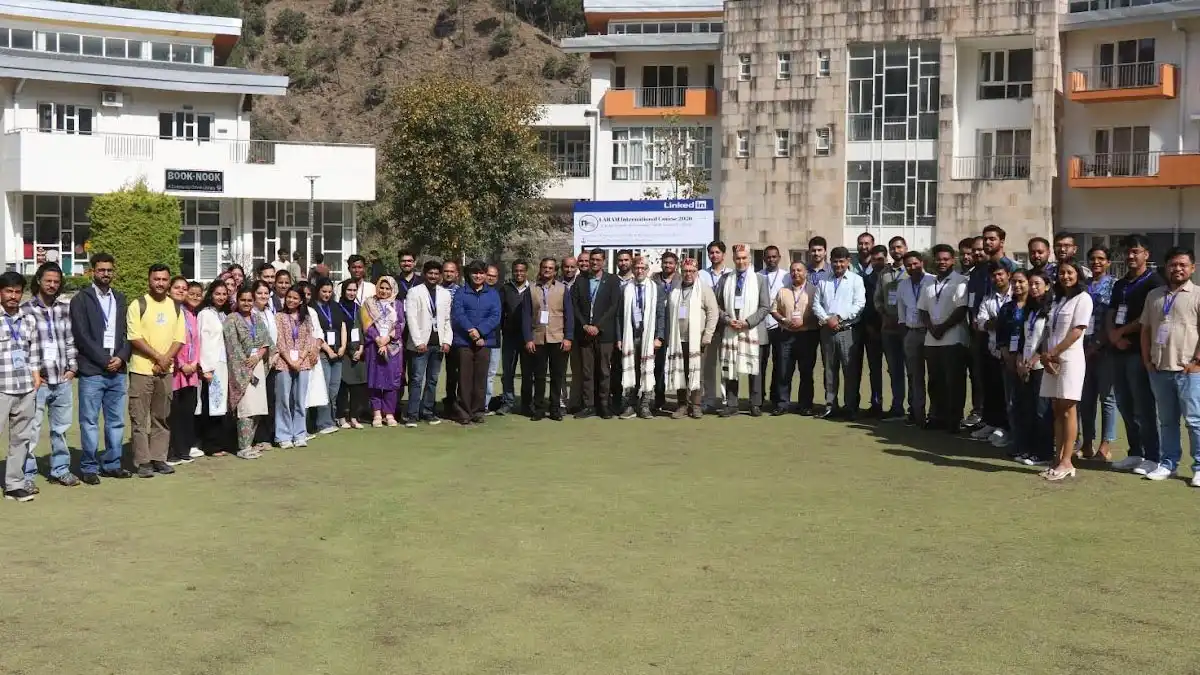
IIT Mandi : The Indian Institute of Technology (IIT) Mandi has officially inaugurated the LARAM Course 2026, a high-level six-day international training programme focused on Landslide Risk Assessment and Mitigation. This prestigious event brings the world-renowned LARAM School from Italy to the Himachal Pradesh campus for the second time in physical mode. Organized by the Centre for Climate Change and Disaster Management (C3DAR), the initiative aims to equip 40 selected researchers and professionals with advanced technical strategies to protect vulnerable mountain communities and critical infrastructure from recurring slope failures.
Global Expertise Meets Himalayan Challenges
The LARAM School, established in 2005 by the University of Salerno’s Geotechnical Engineering Group, has evolved into the global gold standard for disaster management training. By shifting its focus to Mandi, the programme addresses the immediate geographical crisis of the Himalayas. Ten distinguished experts from Switzerland, Italy, Norway, and India are currently leading intensive sessions designed to bridge the gap between theoretical geology and real-world engineering solutions.
Collaborative Shield Against Natural Disasters
This 2026 edition is backed by heavyweight institutions including the National Disaster Management Authority (NDMA), Tata Trusts, and the Anusandhan National Research Foundation (ANRF). The curriculum is not confined to classrooms; it integrates field exposure with scientific lectures to study the fragile geology of Northern India. For the common man in Himachal and neighboring hill states, this research translates into more accurate early warning systems and more resilient highway constructions that can withstand heavy monsoon cycles.
Strengthening International Research Ties
Prof. Settimio Ferlisi, President of the LARAM School, noted that bringing the programme to the Himalayas allows participants to engage directly with one of the most landslide-prone zones on Earth. This hands-on approach is critical for young scientists who are tasked with developing forecasting models. The focus remains on interdisciplinary cooperation, merging civil engineering with environmental science to create a sustainable safety net for the region’s rapid developmental projects.
Driving Regional Development and Safety
Dr. Kala Venkata Uday, Chairperson of C3DAR at IIT Mandi, emphasized that the region faces a “triple threat” of fragile geology, rapid urbanization, and shifting climate patterns. The LARAM Course acts as a knowledge exchange hub where global mitigation strategies are customized for the Indian context. This international collaboration reinforces India’s growing leadership in disaster risk reduction, ensuring that local policymakers have access to the best global data to prevent future tragedies in mountainous terrains.