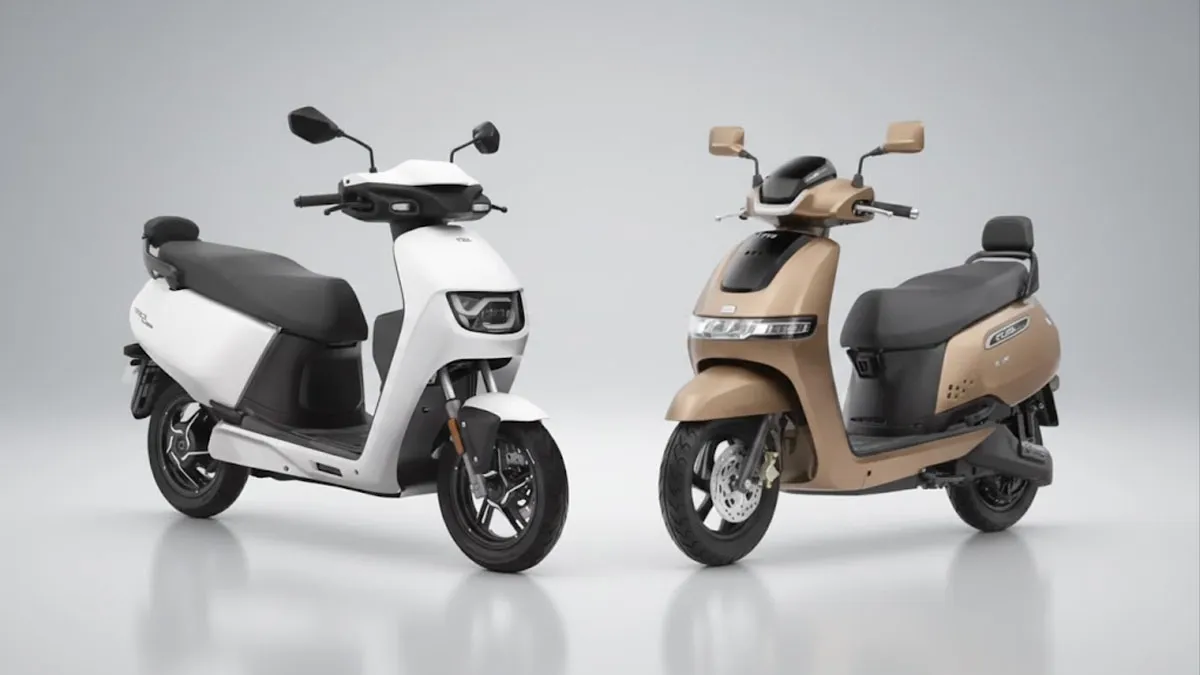
TVS iQube vs Hero Vida : India’s electric two-wheeler market is on fire this year. With petrol prices still high and government incentives making EVs more attractive than ever, families are switching to electric scooters faster than expected. Sales of electric scooters crossed 1.2 million units in the first ten months of 2025 alone, and the family segment—practical, comfortable, and loaded with storage—is leading the charge.
Two models keep coming up in almost every conversation: the TVS iQube ST (3.5 kWh variant) and the Hero Vida VX2 Plus. Both look sharp, promise low running costs, and target the same buyer—someone who needs a reliable daily commuter that can carry groceries, school bags, and occasionally an extra passenger. But when you put them side by side, the differences start to matter.
How Far Can They Really Go—and How Fast Do They Charge?
On paper, the batteries are almost twins. The iQube packs 3.5 kWh while the Vida has 3.4 kWh. Real-world range depends a lot on riding style, but official IDC figures show the TVS claiming 145 km and the Vida 142 km—basically a tie.
Where things change is charging speed. The TVS iQube can hit 80 % in about 3 hours with its 950 W charger, whereas the Vida takes around 4 hours and 15 minutes. For families juggling school runs and office commutes, those extra 75 minutes can feel like a lifetime.
The Vida fights back with a clever trick: two removable batteries. If you live in an apartment without ground-floor parking, you can simply carry the batteries upstairs and plug them into any regular socket. Many owners say this single feature makes city life dramatically easier.
Performance and Ride Feel
The Vida surprises with a slightly peppier motor. It touches 80 km/h, while the iQube tops out at 78 km/h. In daily traffic that 2 km/h rarely matters, but the Vida feels a touch more responsive when you twist the throttle from a standstill—handy when you’re merging onto a busy road with kids on board.
Space That Actually Works for Families
Storage is where the TVS pulls ahead convincingly. Its under-seat boot swallows 32 litres—enough for a full-face helmet plus a laptop bag or two school backpacks. The Vida offers only 27 litres under the seat, though it adds two useful front pockets for bottles, chargers, or wallets. Most parents we spoke to say the iQube’s bigger boot is a deal-clincher on rainy school days.
Tech That Feels Like 2025
Open the TVS and you’re greeted by a bright 7-inch colour touchscreen that looks straight out of a premium car. Navigation, call alerts, music control, over-the-air updates, tyre-pressure monitoring, and even a reverse mode—all standard. The interface is smooth and quick.
The Vida uses a smaller 4.3-inch display. It still gives you Bluetooth, turn-by-turn directions, and cruise control, but the experience feels a generation behind. If you or your teenager love gadgets, the iQube wins hands down.
The Price Question Everyone Asks
Here’s where the Vida shocks everyone. At ₹94,800 (ex-showroom after subsidies in most states), it undercuts the iQube ST by more than ₹33,000. The TVS asks ₹1,27,935 for the 3.5 kWh ST variant. That’s a massive gap—enough to buy a decent smartphone or pay several months of school fees.
So Which One Should You Bring Home?
If your budget is tight and you live in a building where carrying batteries upstairs is a blessing, the Vida VX2 Plus delivers incredible bang for the buck. You sacrifice some boot space and screen wow-factor, but you still get a solid, quick, modern electric scooter for under a lakh.
If you want the complete family package—big storage, fast charging at home, and a dashboard that feels premium every time you ride—the TVS iQube ST justifies the extra cost for many buyers. Running cost is roughly the same (around ₹0.25–₹0.30 per km for both), so over three to four years the price difference shrinks when you factor in peace of mind and resale value.
Either way, 2025 is shaping up to be the year Indian families finally ditch petrol scooters for good—and these two models are leading the revolution.