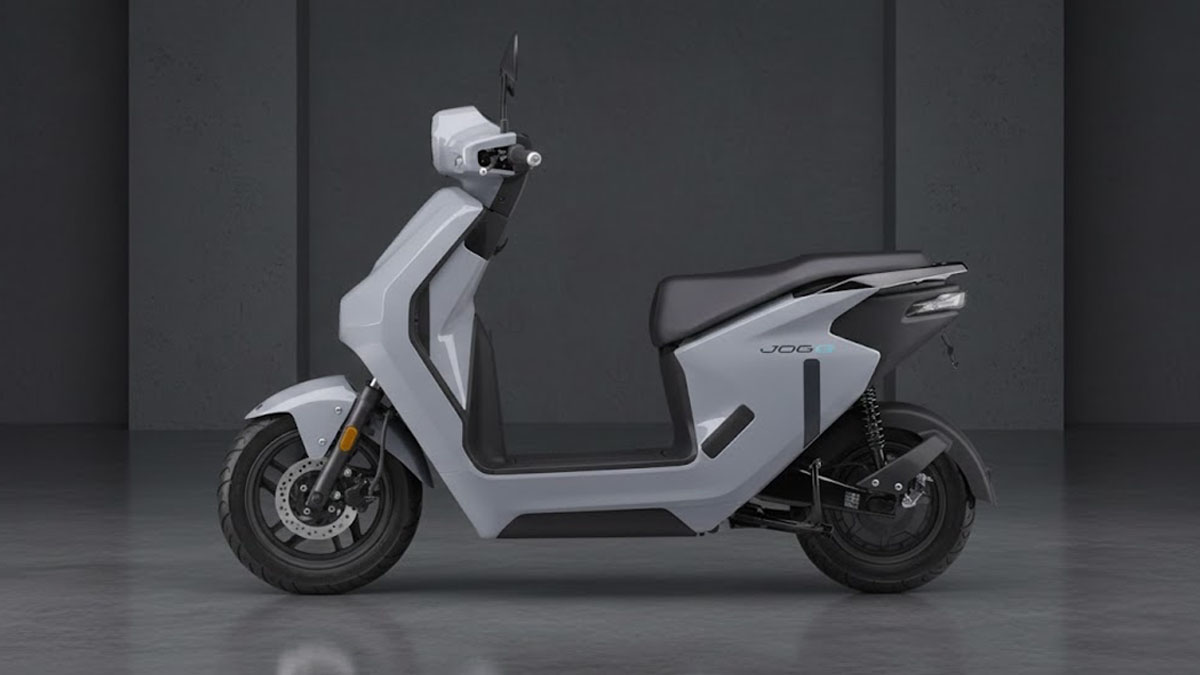
Yamaha Jog E : Imagine pulling up to a station, popping out your dead battery in 30 seconds, sliding in a fresh one, and riding away — no plugs, no waiting. That future just arrived in Japan. Yamaha has quietly released the all-new Jog E electric scooter, but the real headline isn’t the scooter itself. It’s the battery inside: a Honda Mobile Power Pack e: that can be swapped in seconds.
This isn’t just a Yamaha product anymore. It’s the first real-world proof that four fierce Japanese rivals — Honda, Yamaha, Suzuki, and Kawasaki — are actually sharing the same battery under a historic 2022 agreement. For riders, it means the end of range anxiety in cities. For the industry, it could be the breakthrough that finally makes electric two-wheelers practical everywhere, including India.
Why Battery Swapping Could Beat Home Charging
Most electric scooters force you to park for hours while the battery slowly charges. In busy Asian cities, that can mean hunting for a socket or waiting 4–6 hours. Battery swapping flips the script: you treat the battery like a fuel tank. Run low? Swap it in under a minute and go.
Honda’s Mobile Power Pack e: is a 1.3 kWh removable pack weighing about 10 kg. The Yamaha Jog E carries one pack and delivers a real-world range of around 53 km — perfect for daily commuting, deliveries, or school runs. When it’s empty, you roll into a Gachaco swapping station (a new company backed by the four manufacturers), hand over the dead pack, take a fully charged one, and you’re back on the road. No ownership of the battery, just a monthly subscription similar to a phone data plan.
Experts say this model could slash the upfront cost of electric scooters by 30–40% since you’re not buying the expensive battery outright.
How the Yamaha Jog E Performs in the Real WorldDon’t let the modest numbers fool you. The Jog E’s air-cooled AC synchronous motor puts out 1.7 kW (2.3 hp) and a massive 90 Nm of torque from zero rpm. That means instant pull-away in traffic and surprisingly strong hill-climbing for a 93 kg scooter.
You get three riding modes:
- Econ – for maximum range
- Ready – balanced everyday riding
- Speed – quickest acceleration when you need to overtake
Top speed is limited to around 55–60 km/h, which is more than enough for city limits in Japan (and most Indian cities too).Everyday Practicality Built InYamaha kept the Jog E simple, tough, and useful — exactly what made the petrol Jog a 40-year bestseller.
Highlights include:
- Completely flat floorboard for carrying groceries or parcels
- 500 ml bottle holder + USB-A charging port up front
- Big shopping hook and under-seat storage
- Full LED lighting with a sharp polygonal headlamp
- Inverted LCD dashboard that’s easy to read in sunlight
- 135 mm ground clearance and 740 mm seat height — comfortable for riders 5’0″ to 6’0″
Braking comes from a front disc, rear drum, and a combined braking system for extra safety.
Price and Availability in Japan
The Yamaha Jog E goes on sale December 25, 2025, in major cities like Tokyo and Osaka. Base price: ¥159,500 (≈ ₹90,000 or $1,070). That price does NOT include the battery — you sign up separately with Gachaco for the swapping subscription (exact pricing still to be announced, but expected to be affordable for daily users).
Could This Work in India?
Absolutely — and many believe it’s only a matter of time. India already has strong battery-swapping players like Gogoro (in partnership with Hero MotoCorp), Sun Mobility, and Battery Smart. A unified Honda-Yamaha-Suzuki-Kawasaki standard would be a massive boost because service networks and spare parts are already everywhere.
If the same swappable Honda pack appears in future Hero, Honda Activa Electric, Suzuki e-Access, or TVS iQube models, riders could theoretically swap at any station regardless of brand — exactly like filling petrol today. Lower purchase price + instant “refueling” could finally push electric scooters past the 10–15% market share barrier.
The Big Picture
This little Yamaha scooter is far more important than it looks. It proves that even century-old rivals can collaborate when the technology makes sense for customers. If swapping stations grow quickly in Japan, expect the same packs — and the same idea — to spread fast across Asia. The age of “one battery, every brand” has officially begun.